
Economy
Japan's Economy Contracts Nearly 2% Amid US Tariff Impact and Regulatory Changes
Ligaya Almeda
24 Jan, 2026
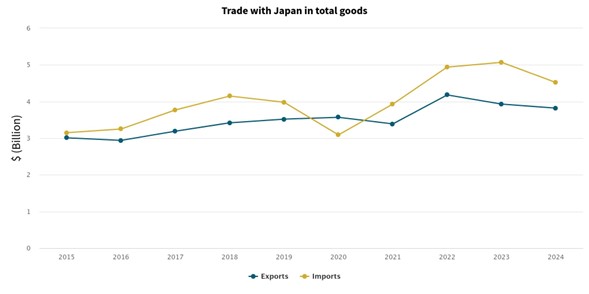
Japan's economy experienced a 1.8% decline in gross domestic product during the third quarter, government data revealed on Monday, marking the first contraction in six quarters. This contraction was primarily driven by a decrease in exports, exacerbated by US tariffs, alongside slowed housing investments due to new energy-efficiency regulations.
Automaker shipments fell sharply, reversing previous export surges made ahead of the tariff impositions. While the new baseline 15% US tariff on most Japanese goods—including autos—has weighed on trade, companies largely mitigated the impact by reducing prices.
"The GDP decline largely stems from temporary factors such as regulatory shifts affecting housing investment," explained Kazutaka Maeda, an economist at Meiji Yasuda Research Institute. "Exports also responded to external pressures. Although growth momentum remains weak, the outlook points to a gradual economic recovery over the next year or two."
Private consumption rose modestly by 0.1%, in line with expectations but below the previous quarter’s 0.4% increase, reflecting caution among consumers amid higher food prices. Capital expenditure, by contrast, grew by a robust 1%, surpassing forecasts and sustaining growth momentum.
Economic revitalization minister Minoru Kiuchi commented, "Private consumption has increased for six consecutive quarters, and capital spending has risen for four quarters, confirming our belief that the economy is on a moderate recovery path."
Despite the slowdown, economists do not anticipate substantial changes to monetary policy based on the latest GDP figures alone. However, Takuji Aida, the chief economist at Credit Agricole and advisor to Prime Minister Sanae Takaichi, cautioned that the Bank of Japan should avoid raising interest rates in December given the economic contraction.
In response to the economic challenges and rising living costs, the government is preparing a significant stimulus package estimated to exceed ¥17 trillion (approximately $110 billion). Finance Minister Satsuki Katayama indicated that measures to improve real income for households would be rolled out between late winter and spring.
Nomura Securities economist Uichiro Nozaki noted, "These fiscal measures are expected to support consumption through the first half of next year, providing a positive underpinning for economic growth."
Looking ahead, analysts surveyed by the Japan Center for Economic Research forecast a 0.6% economic expansion in the final quarter of 2023, signaling optimism for a rebound following the recent downturn.
($1 = 154.63 yen)
Recommended For You

Metro Pacific Investments Reports 14% Increase in Core Net Income Driven by Power and Water Units
Jan 24, 2026
Juancho Mabini

DSWD Urges Public to Support Indigenous Peoples and Street Families Through Organized Programs, Not Alms
Jan 24, 2026
Juancho Mabini

Philippines Aims to Finalize South China Sea Code of Conduct During ASEAN Chairmanship
Jan 24, 2026
Ligaya Almeda
Japan's Economy Contracts Nearly 2% Amid US Tariff Impact and Regulatory Changes
Jan 24, 2026
Ligaya Almeda